Be a Science Week Poet!

Leave a comment

Celia at Science Rhymes is eager to receive your rhyming poems (up to 4 verses) – or Haiku – before the end of July. Adults and children (via an adult email address) are invited to submit their creations to feedback@sciencerhymes.com.au. The resulting FLORA-VERSE online anthology will be celebrating #scienceweek2026.

Our poetry collection is already growing. We’ve received poems about Seed DNA; invasive weeds; endangered wattle; and amazing grass trees. Anything plant-related that includes a touch of science, be it biology, chemistry or other STEM-related perspective, is very welcome.

We are particularly looking forward to publishing poems that feature vegetation found in Australia. From seeds to forests; from flowers to bees, this collection will include your thoughts and discoveries about plants and how they shape environments for a myriad of living things.
The use of AI to help create poems is permitted, but conditions apply. These include acknowledging the AI (such as ChatGPT) with the (human) author’s name; checking AI information for science errors before submitting; and answering 4 simple questions about your experience with using AI for this poem. 1) Were you delighted or disappointed with what AI came up with – give a score out of ten. 2) Did you edit the response? 3) Was your prompt simple or specific? 4) Would you do this again next year?

We still totally appreciate your “human-made” poems for their artistic and literacy values! We trust authors using AI will try to improve the creations they receive through editing and carefully checking facts.

Science Week runs from 15th to 23rd August.
Our deadline for receiving poems is currently Friday 31st July.

Find out more at:
https://www.scienceweek.net.au/event/seeds-to-scenery-poetry/ where you can download the SEEDS TO SCENERY pdf for more details and poem examples. Plus, check out National Science Week Events & Competitions for more activities.

Sturdy Mulga Trees by Celia Berrell

Stretching up towards the skies
or weeping boughs drawn by their sides,
iconic mulga, drab and droll,
still represent Australia’s soul.

In sunburnt soils on arid lands,
with long strong roots, the mulga stands.
High heat; cold nights are mulga’s fate.
In drought these trees can hibernate.

Their rugged bark with groovy tracks
can channel drips down trunks of black.
Instead of leaves, they’ve phyllodes.
Flattened stems that clatter breeze.

Mulga blossoms, tassled gold,
are quick to let sweet-scents unfold.
Flowering not for Spring, but rain.
Should water kiss their harsh terrain.

First published in POINTS OF INTERSECTION SCIENCE AND POETRY (page 35), held in the Scottish Poetry Library.  

Winter Greens by Melanie Hobbs

2 Comments

Mint green is the smell of the gum trees after rain,
of Vicks rubbed onto chests by warm hands.
Moss green is the fuzz beneath my fingertips,
soft wooly jumpers and patterned socks.
Emerald green are the shiny new wellies
with polka-dots that keep feet dry.
Army green is the smears of grass and mud
on the knees of trackpants and footy boots.
Lime green is a chorus of frogs,
a cackle of twenty-eights,
a quaver of silvereyes.
Olive green is my sickly complexion,
the contents of
a crumple of tissues and
a steaming hot bowl of
comforting
pea and ham soup.

Image from Pexels

Nature walk by Jenny Erlanger

Leave a comment

She seemed extremely cheerful
when she greeted us today
and welcomed us so warmly
as we set out on our way.
The tracks were bathed in sunlight
and the sky was powder blue.
The kookaburras chortled
till they had us chuckling too.
The undergrowth was buzzing
and the leaves of all the trees
were waving to each other
as they frolicked in the breeze.

But now she’s in a temper
and she’s grumbling from up high.
I can’t see blue above me,
just an angry looking sky.
The sun’s no longer smiling
and the clouds are turning black.
The rumbling’s sounding louder,
so, it’s time we headed back.
That gentle breeze has strengthened
to become a howling gale.
It’s started raining torrents
and we’re drenched from head to tail.
This monster she’s unleashing
is undoubtedly deranged.
I can’t believe how swiftly
Mother Nature’s mood has changed.

Image from Pexels

Native Australian Red Triangle Slug (Haiku) by Leigh van der Veen

Leave a comment

After rain, timid 

tentacles rise. Gum leaf-like, 

algae grazer, glides.

Photo taken by Leigh van der Veen

Did you know?

Red triangle slugs are Australia’s largest native land slug. They can grow up to 14 cm long. They are safe in your vegetable garden as they prefer the microscopic algae found on smooth-barked eucalypt trees.

Mid-Month Poetry Prompt

Leave a comment

ALLITERATION

Having one, two or three words close together in a sentence or phrase that all start with the same sound is a pleasurable poetic ploy!

Alliterative words can begin with different letters. In the example below, C and Q (and a few of the Ch words) all start with a “K” sound.

Can you write a poem that is more-than-usually-dense in ALLITERATION?

The Gollywumpa by James Aitchison

Leave a comment

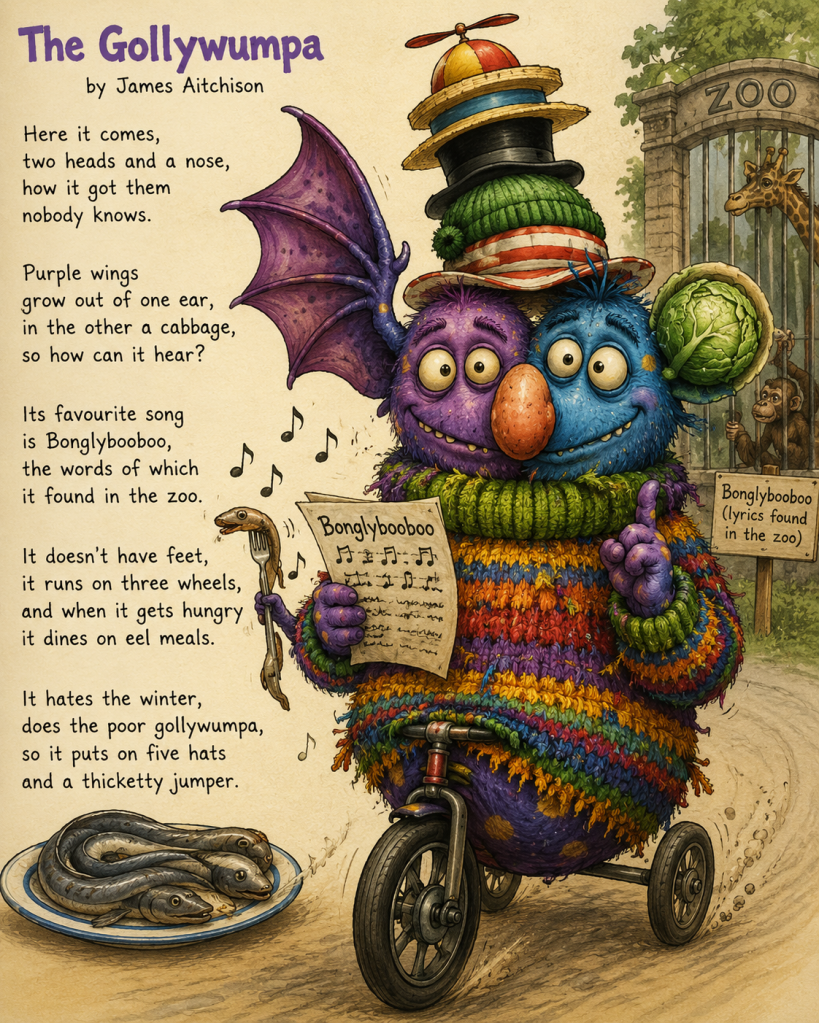
Image created by ChatGPT on reading The Gollywumpa poem

Nonsense with nonce

Introduction: Nonce words are nonsense words created for a specific situation, often in children’s poetry.  In Lewis Carroll’s poem Jabberwocky, he invented the nonce words chortle and galumph, which are now in current use as part of the language.  Perhaps the most famous nonce word — runcible — was created by Edward Lear for his poem The Owl and the Pussycat.  There is no such thing as a runcible spoon.  Lear loved the word so much he wrote about runcible hats, runcible cats and a runcible wall. 

Invite students to invent their own nonce words and use them in poems or stories.  They could also draw what they think their Gollywumpa looks like.

The Gollywumpa by James Aitchison

Here it comes,
two heads and a nose,
how it got them
nobody knows.

Purple wings
grow out of one ear,
in the other a cabbage,
so how can it hear?

Its favourite song
is Bonglybooboo,
the words of which
it found in the zoo.

It doesn’t have feet,
it runs on three wheels,
and when it gets hungry
it dines on eel meals.

It hates the winter,
does the poor gollywumpa,
so it puts on five hats
and a thicketty jumper.